International Metropolis Strategy 2023 | Singapore: Focus on Digital Economy and Green Shipping
[Editor’s Note]
New york, London, Paris, Tokyo, Hong Kong and Singapore, these first-tier international metropolises, what urban grand strategies have been formulated in 2023? These strategies or measures indicate the direction and thinking of the transformation of foreign metropolises, and represent the top-level thinking of these head cities. The series of articles "International Metropolis Strategy 2023" written by the Metropolitan Dynamic Tracking Group of Shanghai Development Strategy Research Institute will comprehensively sort out and deeply interpret the urban strategies of six first-tier international metropolises, and provide reference for Shanghai to better build a socialist modern international metropolis with world influence.
This article is the sixth in a series of articles, and looks at how Singapore formulates urban development strategies in the aspects of digital economy and digital security, green and digital shipping, economic and urban recovery, and overseas strategies of enterprises.
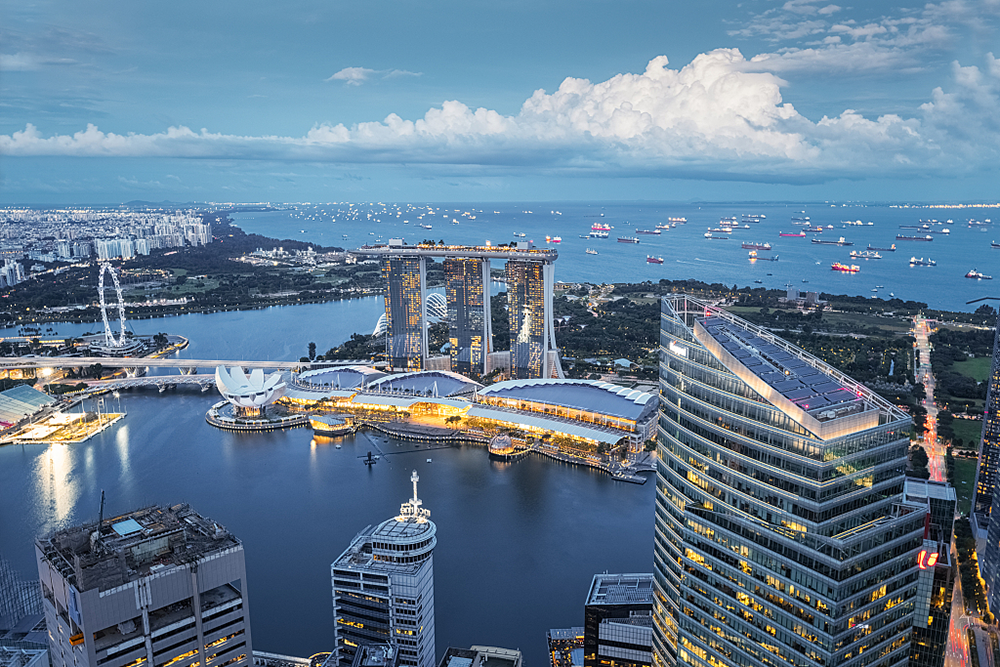 Singapore. Vision china data map
Singapore is located at the southern tip of the Malay Peninsula and at the entrance and exit of the Straits of Malacca. In 2022, it has a total population of 5.64 million, covering an area of 733 square kilometers, with a GDP of 468.12 billion US dollars and a per capita GDP of 83,000 US dollars. According to the forecast of the International Monetary Fund, the growth rate is expected to be 1.5% in 2023, exceeding 470 billion US dollars. In 2023, Singapore’s key strategies mainly focus on digital economy and digital security, green and digital shipping, economic and urban recovery, and overseas strategies of enterprises.
1. Singapore’s digital economy strategy has achieved remarkable results, and the scale of digital economy accounts for 17.3% of GDP.
Singapore released the first "Singapore Digital Economy Assessment", which showed that the scale of Singapore’s digital economy reached 106 billion yuan, accounting for 17.3% of GDP. Singapore is establishing a digital economy accounting system to measure the scale of the digital economy. In 2022, the scale of Singapore’s digital economy will reach S $106 billion, including S $33.1 billion in the information and communication industry.
In terms of digital industrialization, e-commerce, games and network services have the fastest growth rate. In terms of industrial digitalization, financial and insurance, wholesale trade and manufacturing industries have the fastest digital transformation. In addition, in 2022, there were 201,100 digital talents in Singapore, accounting for 5.2% of the total labor force, and the number of digital management and product developers grew the fastest.
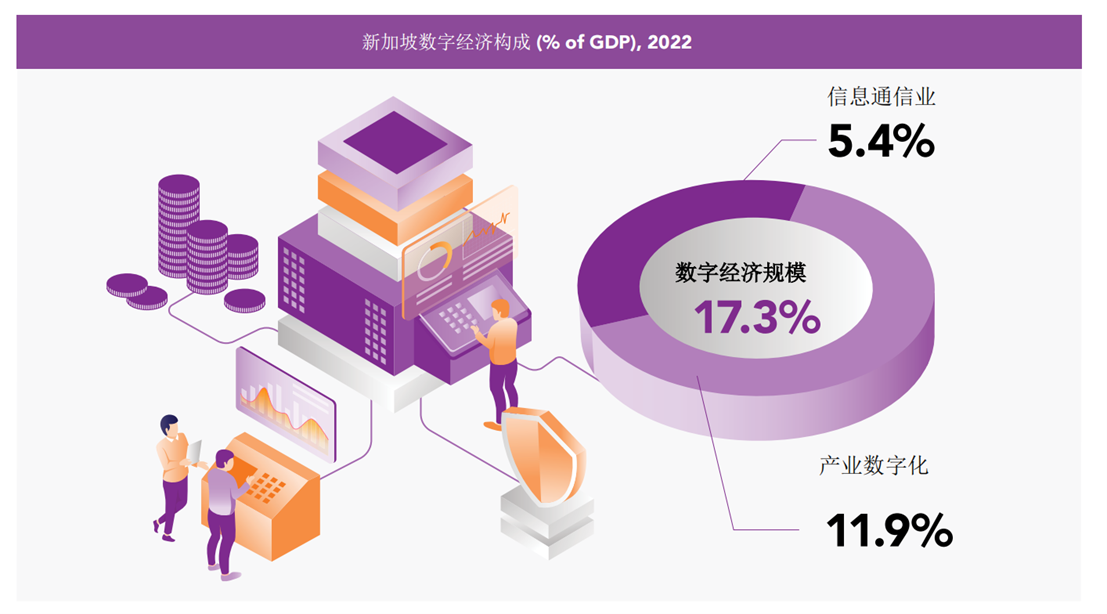 Figure 1 Singapore Digital Economy
2. Singapore Port cooperates with Los Angeles Port and Long Beach Port to establish a green and digital shipping corridor.
In April 2023, the Maritime and Port Authority of Singapore (MPA), the Port of Los Angeles (POLA) and the Port of Long Beach (POLB) signed an agreement to establish green and digital shipping corridors between port complexes under the framework of the international city association (C40 city) to support the decarbonization of the shipping industry, improve efficiency through digitalization, and support the ships docked at the port complexes in San Pedro Bay, Singapore and Los Angeles to transition to low-emission and zero-emission fuels. The agreement also identifies digital shipping solutions and sets standards and best practices for green ports and alternative marine fuel refueling, including sharing experiences on international platforms such as IMO.
By the end of 2022, there are 21 green shipping corridors in the world, including the ports of Shanghai and Los Angeles. Ports, shipping companies, fuel suppliers and other shipping industry chain stakeholders in the green shipping corridors have signed up to cooperate, and by introducing innovative technologies and adopting new fuels, greenhouse gas emission reduction or even zero emission targets can be achieved on specific routes.
3. Singapore will build an employment skill system centered on engineering training to enhance the employability of green economy.
As of June 2023, the unemployment rate in Singapore remained at a low level of 2.1%, and many indicators monitored by Singapore, such as the number of employed people in 2023, the long-term unemployment rate of residents, the number of laid-off people and the re-employment rate of laid-off residents within six months, were better than those in 2019. The Employment Skills Insight Report released by Singapore will build an employment skills system centered on engineering training, focusing on the energy levels of engineers and technicians in the green economy. The report emphasizes that from 2023 to 2030, Singapore’s national skills will focus on engineering training to support Singapore’s Green Plan 2030.
4. Singapore actively builds the world’s leading national digital trust center to enhance digital security and cross-border mobility convenience.
Singapore has established the National Digital Trust Center, with an investment of S $50 million. It will build a world-leading digital trust technology center from four aspects: trust technology research, trust technology innovation, new sandbox environment and new digital trust talents. At present, the center has cooperated with Britain and other countries on cross-border data flow and digital contracts. Singapore’s move is also regarded as an important measure to build a global digital financial center.
5. Singapore has built a large language model to meet the needs of multiculturalism and multilingualism, and is committed to building a language network.
Singapore took the lead in launching the flagship artificial intelligence project costing S $70 million to develop the first large-scale language model ecosystem in Southeast Asia to meet the diverse cultural and language needs of the region, and at the same time help Singapore become the global leader in artificial intelligence solutions in 2030. At present, Singapore Artificial Intelligence (AISG) has launched the first Southeast Asian Language Network (SEA-LION) system to support Singapore to become the language and voice center of Southeast Asia.
6. Singapore launched artificial intelligence strategy 2.0 to enhance its economic potential.
Singapore’s artificial intelligence strategy 2.0 aims to meet the challenges of today’s era and enhance Singapore’s economic and social potential in the next three to five years. Version 1.0 of artificial intelligence strategy was released in 2019, focusing on the application of artificial intelligence in education, medical care and social security. Version 2.0 of artificial intelligence will focus on the artificial intelligence ecosystem and support innovation and economic development through artificial intelligence, with the theme of "AI for public good, for Singapore and the world".
7. The HDB system in Singapore will be greatly adjusted and optimized, and the inclusiveness will be further enhanced.
In August 2023, Singaporean Prime Minister Lee Hsien Loong announced that he would further reform the HDB system, including changing the classification of HDB from the existing "mature/immature areas" to "standard/preferred/golden areas", and setting stricter resale conditions and holding periods for the latter two HDB. For example, the minimum holding period (MOP) of HDB in gold and preferred lots will be raised from 5 years to 10 years, and the purchase allowance will also be refunded at the time of sale. To achieve "ensuring that people of all salary classes can afford HDB flats, ensuring that every town and region has a good social mix, allowing people of different classes to live in HDB flats, and ensuring that the system is fair to all." The new classification of HDB is expected to curb the rapid rising trend of existing HDB prices and ease the contradiction of demand.
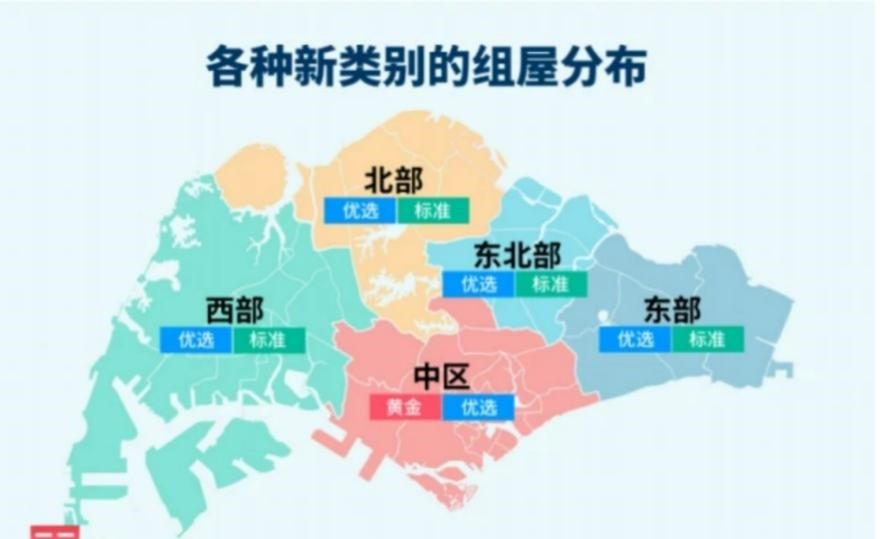 Figure 2 Distribution of various new types of HDB under the new system
8. Singapore Enterprise Development Board has established overseas sub-centers to continuously expand its overseas network.
During Prime Minister Lee Hsien Loong’s visit to the United States, the Singapore Enterprise Development Agency opened an overseas sub-center in San Francisco to serve the innovative activities of Singaporean enterprises in San Francisco. Singapore took a fancy to San Francisco’s innovation system and ecology, focusing on enhancing the cooperation between the two innovation systems and ecology. At present, about 200 companies in Singapore have set up regional headquarters in the United States, covering medical care, financial technology, consumer technology, manufacturing and retail. In the past five years, the number of Singaporean companies in the United States has increased by 23%.
9. Singapore has gradually expanded its digital Singapore dollar electronic money experiment.
The Singapore government outlined the infrastructure needed to digitize the Singapore dollar, and announced that it would expand the experiment in digital currency. Monetary authority of singapore (MAS) will also issue a real-time central bank digital currency (CBDC) for batch settlement, and plans to start developing CBDC for batch interbank settlement in 2024. The expanded digital currency experiment will cover four areas: token bank liabilities, wallet interoperability, supplier financing and institutional payment control. These will be carried out with industry participants including various commercial organizations and financial institutions to check related infrastructure components and business models. At the same time, Ant International, Fazz(Note: a digital payment financial service platform, which was formed by the merger of Indonesia Payfazz and Singapore Xfers Company)And Grab(Note: South Asia Network Car Rental and Food Delivery Platform Company provides services including online car rental, food delivery, hotel reservation, online banking, mobile payment and insurance. )The pilot will be launched around the concept of special currency to facilitate Alipay users to pay GrabPay merchants.
10. Singapore started to formulate relevant technical standards after completing the first marine methanol fuel replenishment.
Replacing low-carbon fuel with methanol is a strategy to decarbonize the shipping industry, which accounts for 3% of global greenhouse gas emissions. Singapore carried out the first methanol filling operation in July 2023, which may pave the way for methanol to be used as marine fuel. With the global delivery of methanol ships, more methanol filling operations will be planned in the coming year.
After the first operation, the Singapore Chemical Industry Council and the Standards Development Organization of Singapore Maritime Safety Administration (MPA) will formulate technical references for the operation and safety requirements of methanol filling. The Singapore Maritime Bureau will also lay a further foundation for the establishment of commercial methanol operations, including licensing and infrastructure requirements. As the shipping industry moves towards full decarbonization, methanol is an important substitute.

The proportion of digital economy and green economy in Singapore has increased, and HDB reform has been carried out.
Over the past two years, Singapore has become the "online celebrity City" in Asia. Excellent urban management, stable political system, never-absent scientific and technological layout and forward-looking overseas strategy make Singapore an "investment paradise".
In 2023, the exchange rate of Singapore dollar against Malaysian ringgit rose all the way, and the enthusiasm of Singaporeans for spending across the Johor Strait to Johor Bahru and other places continued to rise. Tharman shanmugaratnam won with 70.40% of the vote and became the ninth Singaporean president.
In 2023, the proportion of digital economy and green economy in Singapore’s urban strategy increased significantly. In particular, the digital economy has enabled Singapore to once again break through the restrictions of narrow space (the last breakthrough was the establishment of major industrial parks overseas) and play a greater role in the virtual space. Singapore’s path to developing green economy has always been clear: if it can’t completely win from technology and economies of scale, then it should participate in the global green economy competition in the formulation of standards and frameworks.
Finally, talk about the HDB system in Singapore. Since the era of Lee Kuan Yew, Singapore has adhered to the concept that "people’s livelihood is the greatest democracy". Du Fu’s poem-"There are thousands of buildings in Ande" still hangs in the hall of Singapore Housing Bureau. HDB has solved the housing problem of 70% Singaporeans. Singapore has also reserved the area around the subway station with the best location, the most mature facilities and the most complete facilities for HDB. Compared with other metropolises, Singapore is a veritable "people’s city". In 2023, the detailed measures of Lee Hsien Loong’s HDB reform were obviously to improve the inclusiveness of HDB and strengthen the residential property of HDB again.
(This paper is one of the series of research results of the research group of metropolitan dynamic tracking of Shanghai Development Strategy Institute, and the members of the research group include Dai Yuehua, Grace Wai Wong and Liu Ziyu.)